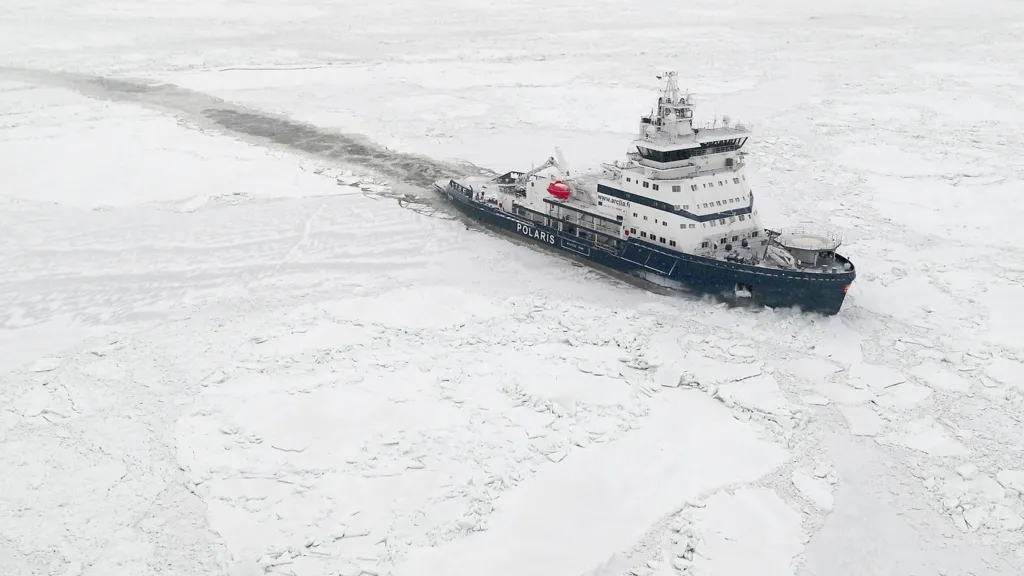
The United States is turning to Finland to rapidly strengthen its presence in the Arctic. President Donald Trump has ordered four new icebreakers from Finnish shipyards, with plans for seven more based on Finnish designs to be built domestically. This move directly supports the US goal of countering Russian and Chinese activity in the resource-rich, increasingly accessible Arctic region. Finland designs 80% of the world’s icebreakers, making it the undisputed global expert. The US is buying icebreakers from this niche leader to close a stark capability gap with Russia, which operates around 40 such vessels.
The first contracts were awarded in late December. Rauma Marine Constructions in Finland will build two ships, with the first delivery expected in 2028. An additional four will be constructed in Louisiana using a design from Finland’s Aker Arctic Technology. President Trump waived a law requiring US-built Coast Guard vessels, citing urgent national security needs. He stated the US is buying “the finest icebreakers in the world” to address “aggressive military posturing” by foreign adversaries. This procurement is a tangible part of the broader US focus on the Arctic, which includes Trump’s contentious push to acquire Greenland.
Why Finland is the Global Icebreaker Superpower
Finland’s dominance stems from geographic necessity. “Finland is the only country in the world where all the harbours may freeze during wintertime,” explains Maunu Visuri, head of Finnish operator Arctia. With 97% of goods arriving by sea, icebreakers are critical infrastructure. This demand has fostered a unique ecosystem of designers, builders, and operators over a century. Finnish companies have perfected hull forms that break ice by bending it downward, not cutting it, and have streamlined production to build complex vessels in under three years.
The testing process is rigorous. At Aker Arctic’s Helsinki ice lab, scale models navigate a 70-meter frozen tank. Engineers like Riikka Matala ensure designs have sufficient structural strength and engine power. This deep expertise is why the US is buying icebreakers from Finland rather than developing them independently. The partnership provides immediate access to proven technology and accelerates the US fleet expansion by years, a critical advantage in the race for Arctic influence.
The Strategic Arctic Context: Russia, China, and New Routes
The urgent US need stems from a changing Arctic and heightened competition. Climate change is opening new trans-Arctic shipping routes above Russia and North America, reducing travel time between Asia and Europe. It also makes vast oil and gas reserves more accessible. Russia, with its long Arctic coastline, has invested heavily, deploying around 40 icebreakers, including nuclear-powered ones. China, while lacking Arctic territory, is increasing its fleet of polar-capable “research” vessels, operating in waters the US considers its exclusive economic zone.
Retired US Navy officer Peter Rybski notes the increased traffic. “You have an active oil and gas exploration… as well as a newly-emerging trans-shipment route,” he says. With only three operational icebreakers, the US cannot monitor or assert control in these waters. Icebreakers are the primary tool for Arctic power projection. As researcher Lin Mortensgaard notes, “you cannot sail your aircraft carrier into the central Arctic Ocean.” Thus, the US is buying icebreakers to establish a credible, permanent naval presence in the region.
The Procurement Plan and National Security Waiver
The plan involves 11 new “Arctic Security Cutters” for the US Coast Guard. Four will be built in Finland, and seven will be constructed in US shipyards using Finnish designs and technical support. Trump’s waiver of the Jones Act, which mandates US-built coastguard vessels, underscores the urgency. The administration framed it as essential to counter “foreign adversaries” quickly. This allows the US to bypass a slower domestic development process and leverage Finland’s ready expertise.
The first Finnish-built vessels will arrive by 2028. The US-built ships will follow, creating a sustained pipeline of new capability. This hybrid approach aims to rapidly field assets while rebuilding domestic shipbuilding capacity for the long term. The decision highlights a pragmatic shift: when facing a specialized capability gap, the US is buying icebreakers from the best source to achieve strategic goals faster than internal development would allow.
Broader Implications for Arctic Geopolitics
The US investment signals a new phase of Arctic militarization. It is a direct response to Russian and Chinese moves, ensuring the US can protect its economic interests and enforce sovereignty. The icebreakers will enable year-round patrols, support scientific research that underpins territorial claims, and ensure access to emerging shipping lanes. This buildup risks escalating tensions in a region previously characterized by scientific cooperation.
For Finland, the orders are a major economic and diplomatic win, cementing its role as a key US security partner in Northern Europe. The collaboration also indirectly supports NATO’s northern flank. However, the overarching US focus on the Arctic, exemplified by both the icebreaker purchase and the Greenland obsession, suggests a sustained re-prioritization. The region is no longer a peripheral ice sheet but a central theater of 21st-century great power competition, and the US is buying icebreakers to ensure it is not left behind.