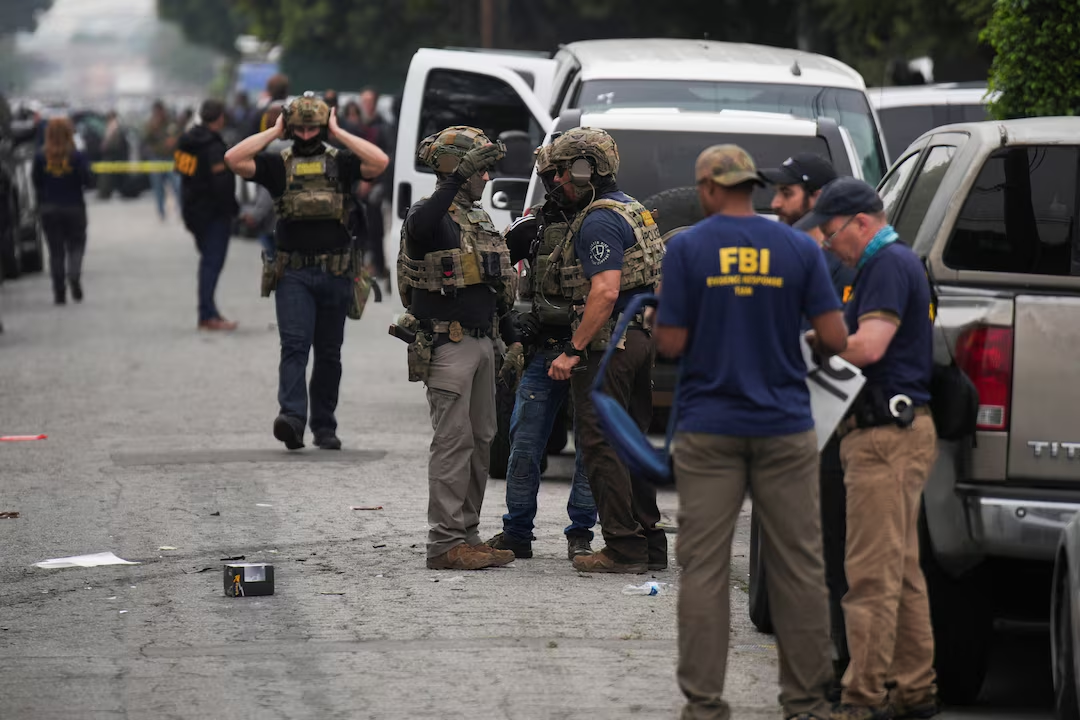
The Trump administration has cut more than 4,000 employees from some of the nation’s top law enforcement agencies. It did this even as it vowed to crack down on crime. Reuters obtained records from the U.S. Justice Department’s management unit. The records show that total FBI employment has dropped more than 7% since the government’s 2024 fiscal year. That loss represents about 2,600 people. The Drug Enforcement Administration’s staff dropped by about 6%. The Bureau of Alcohol, Tobacco, Firearms and Explosives lost about 14% of its workers. Therefore, the DOJ law enforcement job cuts are substantial.
Other parts of the Justice Department shrank even more rapidly. Its National Security Division, which handles intelligence and terrorism matters, lost nearly 38% of its staff. The division’s most recent budget request to Congress noted “unprecedented personnel constraints” in the unit that handles espionage cases and sensitive military technology exports. “It’s the difference between being proactive and entrepreneurial or purely reactive to the most obvious imperative of the day,” said Adam Hickey. He is a former senior official in the National Security Division.
Records Show Accelerating Pace of Departures
These records offer the most detailed accounting to date. They show the extent to which the Trump administration has downsized premier law enforcement agencies. These agencies traditionally handle the government’s highest-profile criminal investigations. Their work includes combating terrorism, deterring drug traffickers, and keeping guns away from criminals. Other records show an increasing pace of departures after Trump began his second term in January 2025.
“The administration talks a big game when it comes to crime and terrorism,” said Stacey Young, a former Justice Department lawyer. “But the fact that it’s hollowing out agencies tasked with addressing them shows that they don’t stand behind their words.” Young leads Justice Connection, a group that supports staff leaving the department. The contraction, combined with an increased focus on immigration, has caused authorities to pull back from some typical work. Federal prosecutions for drug trafficking dropped to their lowest level in more than two decades last year.
Justice Department Defends Staff Reductions
Justice Department spokeswoman Natalie Baldassarre said that buyouts last year allowed the agency to shed people. She claimed these people “did not want to aggressively and faithfully tackle crime to protect the American people.” She said that the U.S. murder rate has fallen to its lowest rate in recent history. “Any suggestion that this reduction in force has hampered our ability to tackle violent crime is not based in reality,” she added.
The Trump administration has made deep cuts across the federal government. These cuts began last year in the first months of his presidency. One of the few exceptions was immigration enforcement. That arm of government secured billions in additional funding as the administration pressed to deport more people. Trump-appointed officials have also fired or forced out dozens of federal prosecutors and agents. These people worked on investigations of the president and his political allies. Officials have also launched new cases targeting his adversaries.
Civil Rights and Environmental Divisions Hit Hard
The records show the number of filled and unfilled positions in each section of the Justice Department as of early April. The department now employs around 107,000 people. That is about 11,200 fewer people than during the fiscal year that ended before Trump began his second term. The cuts came amid an administration effort to shrink government and upheaval at the Justice Department. Thousands of workers have taken buyouts. Officials have also struggled to fill some jobs, leaving about 7,000 positions unfilled.
The section responsible for environmental law lost about a third of its staff. The department’s Civil Rights Division lost more than half. The Bureau of Prisons shed more than 2,200 employees, about 6% of its workforce. The Justice Department’s internal watchdog has said the Bureau of Prisons is in a “staffing crisis.” The number of inmates in federal custody has remained largely unchanged. As a result, some guard posts have gone empty. Others have been staffed with teachers and nurses pulled from their regular positions. One prison official spoke on condition of anonymity for fear of retaliation. The DOJ law enforcement job cuts have real consequences for prison operations.
Critics Warn of Long-Term Damage
“The department has been filled with career public servants with specialized expertise,” said Amy Solomon. She is a senior fellow at the Council on Criminal Justice and a former department official. “They have served Republican and Democratic administrations over years or decades. To cut that workforce is a huge disservice to our communities and our country.” The DOJ law enforcement job cuts remove institutional knowledge that cannot easily be replaced. The government is bringing even fewer drug trafficking cases this year. Reuters found this after reviewing millions of federal court dockets from Westlaw, a legal research service. The full impact of these cuts may take years to fully understand. For now, the nation’s top law enforcement agencies operate with significantly fewer staff. Their ability to investigate complex crimes has diminished. The Trump administration has chosen to prioritize immigration enforcement instead. The DOJ law enforcement job cuts represent a fundamental shift in federal law enforcement priorities.