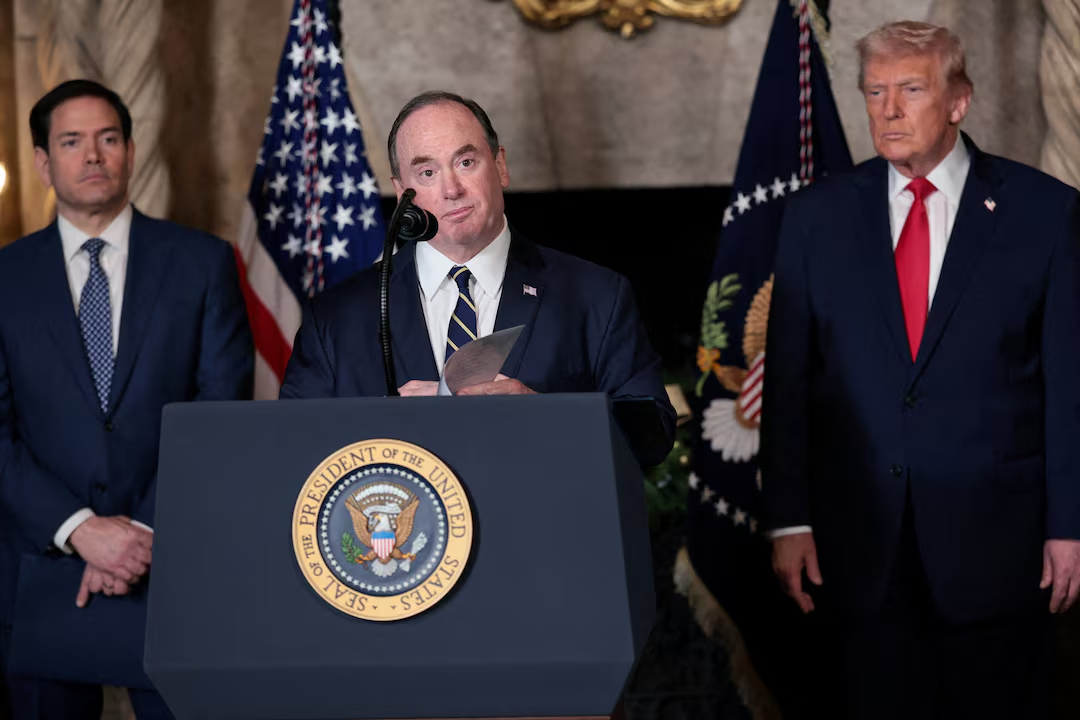
Navy Secretary John Phelan has been fired, a U.S. official and a person familiar with the matter said on Wednesday. This marks another wartime shakeup at the Pentagon. It comes just weeks after Defense Secretary Pete Hegseth ousted the Army’s top general. The Pentagon announced his departure in a brief statement. It said he was leaving the administration “effective immediately.” However, it did not provide a reason. It also did not say whether leaving was his decision. Therefore, the Navy Secretary Phelan firing has raised questions about leadership stability.
The sources spoke on condition of anonymity. They said Phelan was dismissed in part because he moved too slow to implement reforms to speed shipbuilding. He had also fallen out with key Pentagon leadership. One source cited bad relationships with Hegseth, Hegseth’s deputy Steve Feinberg, and the Navy’s No. 2 civilian, Hung Cao. The Pentagon said Cao will now take over as acting Navy secretary. The source also cited an ethics investigation into Phelan’s office.
Phelan’s Departure Follows Pattern of Pentagon Upheaval
A billionaire seen as having close ties to President Donald Trump, Phelan is the first administration-picked service secretary to be fired since Trump returned to office last year. His departure fits within a broader context of upheaval at all levels of Pentagon leadership under Hegseth’s watch. This includes the firing last year of the chairman of the Joint Chiefs of Staff, Air Force General C.Q. Brown. Hegseth also fired the chief of naval operations and the Air Force vice chief of staff.
On April 2, Hegseth fired Army Chief of Staff Randy George without citing a reason. Two U.S. officials said the decision was tied to tensions between Hegseth and Army Secretary Daniel Driscoll. The Navy Secretary Phelan firing thus continues a pattern of removing senior military leaders.
Senator Reed Calls Dismissal ‘Troubling’
Senator Jack Reed, the top Democrat on the Senate Armed Services Committee, called Phelan’s dismissal “troubling.” “I am concerned it is yet another example of the instability and dysfunction that have come to define the Department of Defense under President Trump and Secretary Hegseth,” Reed said. The Navy Secretary Phelan firing has drawn bipartisan scrutiny.
The latest departure comes during a tense ceasefire with Iran. The U.S. is flowing more naval assets into the Middle East. The U.S. military is relying on naval assets to carry out a blockade of Iran. President Trump hopes this blockade will pressure Tehran to negotiate an end to the conflict on his terms. Therefore, the Navy Secretary Phelan firing occurs at a critical strategic moment.
Navy Faces Intense Pressure to Expand Fleet
The Navy is under intense pressure to expand its fleet. China’s shipbuilding industry now dwarfs the U.S., which was once a global powerhouse. Trump’s $1.5 trillion defense budget request for fiscal year 2027 includes over $65 billion to procure 18 warships and 16 support ships. These ships are made by General Dynamics and Huntington Ingalls Industries. This is part of what the Pentagon is calling the “Golden Fleet” initiative. Officials say this is the largest shipbuilding request since 1962.
Phelan’s dismissal raises questions about who will lead the Navy through this expansion. Acting Secretary Hung Cao now takes over. Cao must navigate the same shipbuilding challenges that reportedly led to Phelan’s firing. The Navy Secretary Phelan firing may slow momentum on the Golden Fleet initiative. Alternatively, a new secretary might move faster. Either way, the Pentagon’s leadership turmoil continues. The Navy needs clear direction as it confronts Iran and competes with China. The coming weeks will reveal whether Hegseth appoints a permanent replacement quickly. For now, the Navy Secretary Phelan firing leaves a leadership vacuum at a crucial time.