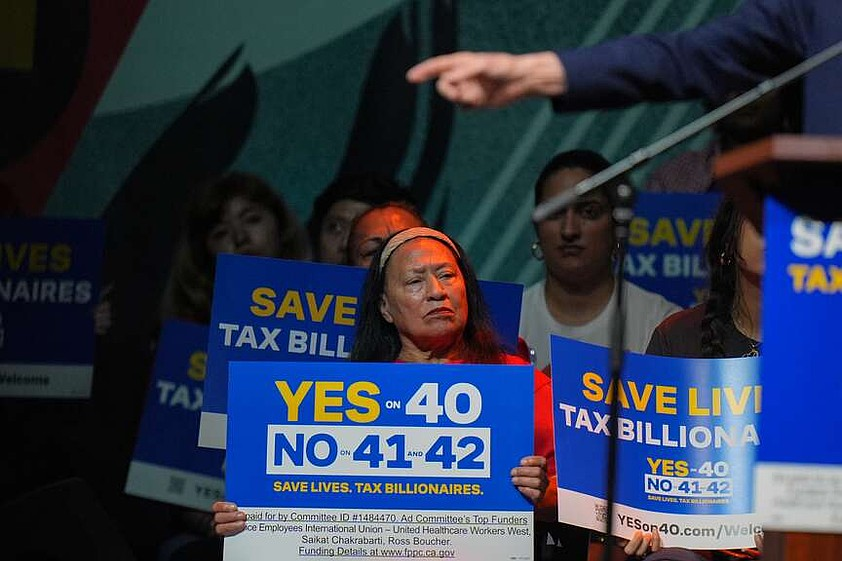
California’s proposed billionaire wealth tax remained uncalled on Wednesday, November 4, as officials continued counting votes in a contest over healthcare funding, inequality and the state’s reliance on wealthy taxpayers.
Proposition 40 would impose a one-time 5% tax on the wealth of California residents whose net worth exceeds $1 billion, directing most of the proceeds towards healthcare.
Early returns favoured opponents, but the Associated Press had not declared an outcome. Even if the proposal ultimately secures majority support, two competing ballot measures could prevent it from taking effect.
What California’s Billionaire Tax Would Do
The proposal targets accumulated wealth, rather than simply the income a person earns in a particular year.
Supporters argue that a one-time contribution from California’s wealthiest residents could help protect healthcare services facing federal funding reductions.
The campaign is led by SEIU United Healthcare Workers West, which estimates that California will lose $100 billion in federal healthcare funding over five years. That figure is the union’s estimate of the funding shortfall.
Backers say the measure would help prevent those reductions from weakening access to care. Lorena Gonzalez, president of the California Federation of Labor Unions, has argued that collecting the tax is necessary to protect the healthcare system.
The campaign has also attracted support from Vermont Senator Bernie Sanders, who appeared at rallies promoting the proposal.
Early Results Favour Opponents, but the Outcome Is Unresolved
The election-night count showed more votes against Proposition 40 than in favour, while substantial numbers of ballots remained outstanding.
An uncalled result does not necessarily mean the current vote totals are evenly divided. It means the available count has not yet established a sufficiently certain outcome.
For now, the proposal remains a ballot measure awaiting a result. California has not enacted the billionaire tax through this vote.
Why Some Democratic Allies Oppose the Measure
The campaign has divided organisations that frequently work together on Democratic policy priorities.
Planned Parenthood and the California Teachers Association are among the groups in a coalition opposing the measure, according to the AP report.
Their concerns include how the proceeds would be allocated and whether wealthy residents leaving California could weaken the state’s finances.
California depends heavily on personal income taxes paid by its highest earners. Opponents argue that losing some of those taxpayers could reduce recurring revenue, potentially affecting services beyond healthcare.
Supporters, meanwhile, contend that the immediate funding threat requires an exceptional response from residents with the greatest financial resources.
The disagreement centres partly on whether the proposed one-time revenue would outweigh potential longer-term budget consequences.
read Also; Brian Acton Net Worth: How WhatsApp Made Him a Billionaire
Billionaire Contributions Fuel an Expensive Campaign
Opponents raised roughly 10 times as much money as supporters, according to AP’s reporting, with technology executives and venture capital investors providing substantial backing.
The political action committee Building a Better California raised more than $333 million. Approximately 30% of that amount came from Google co-founder Sergey Brin.
The committee supported measures designed to block the proposed wealth tax, adding another layer to the campaign.
AP also reported that Brin and fellow Google co-founder Larry Page began reducing their ties to California after the proposal emerged.
Meta chief executive Mark Zuckerberg took a different approach, saying he would remain in California for eight years and reaching an arrangement with Meta intended to help him meet a potential tax obligation without surrendering his ownership stake.
Those individual responses illustrate how the proposal has already influenced planning among some of the people it could affect.
Competing Measures Could Block the Tax
A majority “yes” vote on Proposition 40 would not necessarily settle whether the tax takes effect.
Under the ballot provisions described in the AP report, it could be blocked if either competing measure passes and receives more affirmative votes than the wealth-tax proposal.
The countermeasures include a prohibition on new taxes on financial assets and other personal property, excluding real estate.
That makes the relative vote totals important. Observers must follow the outcomes of the competing proposals alongside Proposition 40 itself.
Healthcare Funding Remains the Central Question
The campaign has exposed a disagreement over how California should respond to pressure on public services while maintaining a stable tax base.
Supporters see billionaire wealth as a source of emergency healthcare funding. Opponents question the measure’s structure and warn that taxpayer departures could create new budget problems.
With the result still unresolved, the immediate focus remains on outstanding ballots and the competing measures. Their combined outcomes will determine whether the proposed levy can proceed.
Read Also; T&T Opens First California Store in San Jose