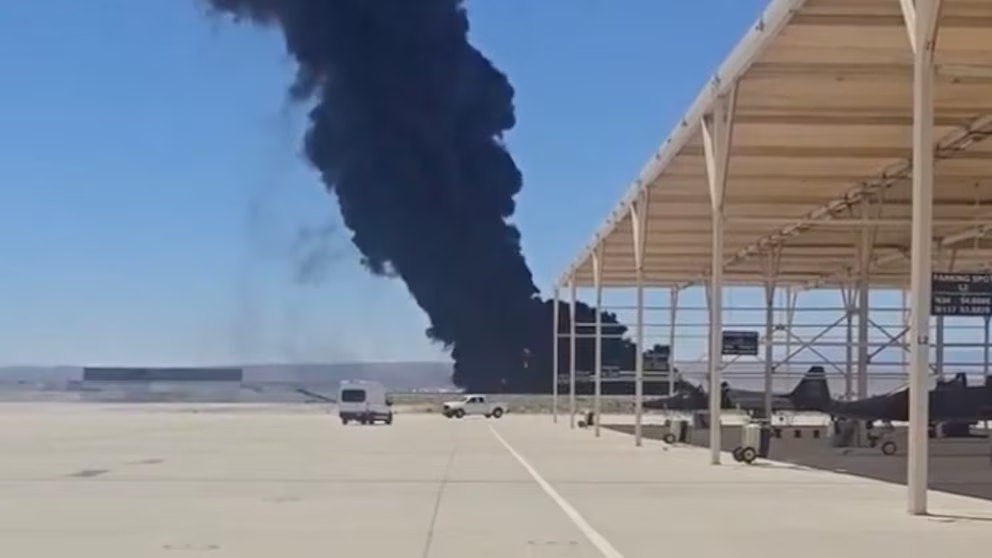
The deadly crash occurred shortly after takeoff during a routine test mission at one of America’s most important military aviation testing sites.
A B-52 bomber crash at Edwards Air Force Base in California has killed eight people after the aircraft went down shortly after takeoff during a routine test mission.
The U.S. Air Force said the B-52 Stratofortress crashed at about 11:20 a.m. local time on Monday at the Edwards airfield in Southern California’s Mojave Desert. Emergency crews responded immediately, but officials later confirmed that the crash was not survivable.
The incident has shaken one of the U.S. military’s most important aviation testing hubs. Edwards Air Force Base is known for advanced flight research, test missions and aircraft development programs. It is home to the Air Force Test Center and the U.S. Air Force Test Pilot School.
The cause of the crash has not yet been determined. Military investigators are expected to review flight data, maintenance records, mission planning and conditions at the time of takeoff.
B-52 bomber crash leaves eight dead
The B-52 bomber crash involved eight people who were on board the aircraft for a test mission. Officials said the aircraft went down shortly after leaving the runway.
The Air Force described the mission as routine, but early assessments showed that the crash was not survivable. Authorities did not immediately release the names of those killed as families were being notified.
Boeing later said two of its employees were among those on board. The company said it was in contact with their families and offering support.
The crash also forced Edwards Air Force Base to suspend some operations and divert incoming aircraft. Images from the area showed heavy smoke rising from the base after the aircraft went down.
Edwards Air Force Base plays key test role
The crash happened at a base with deep importance in American aviation history.
Edwards Air Force Base covers a large area in Kern County and has long been used for experimental aircraft testing. It is the site where pilot Chuck Yeager broke the sound barrier in 1947, one of the most famous moments in aviation history.
Today, the base remains central to U.S. military flight testing. It supports aircraft research, training, evaluation and modernization programs.
That role makes the B-52 bomber crash especially significant. Test missions are designed to evaluate aircraft systems, performance and upgrades, often under carefully controlled conditions. When a deadly accident occurs during such a mission, it usually triggers a detailed investigation.
What investigators will examine
The investigation into the B-52 bomber crash is expected to focus on several areas.
Officials will likely study the aircraft’s maintenance history, engine performance, flight controls and any systems being evaluated during the test mission. They may also examine communications between the crew and ground control before the crash.
Weather, runway conditions and takeoff procedures may also form part of the review.
Military aviation investigations can take months to complete. Investigators usually avoid early conclusions until technical evidence has been analyzed.
For now, officials have only confirmed the timing of the crash, the number of people on board and the early finding that the accident was not survivable.
B-52 remains central to US airpower
The B-52 Stratofortress is one of the longest-serving aircraft in the U.S. Air Force.
First introduced in the 1950s, the bomber has remained in service through several generations of military technology. The Air Force has continued to modernize the fleet, including work on updated engines, radar and other systems.
The aircraft is valued for its long range, endurance and ability to support major strategic missions. Despite its age, the B-52 is expected to remain part of the U.S. bomber force for decades.
That long service life has made modernization a major priority. Test programs at bases such as Edwards are part of that effort.
Boeing employees among those killed
Boeing confirmed that two of its workers were aboard the aircraft when it crashed.
The company said it was supporting their families following the accident. Their presence on the aircraft suggests the mission may have involved technical support connected to testing or modernization work.
The Air Force has not yet released full details about the roles of everyone on board. Such information is usually provided after family notifications and early investigation steps are complete.
B-52 bomber crash raises safety questions
The B-52 bomber crash will likely lead to renewed attention on military aircraft safety, testing procedures and the demands of keeping older aircraft in service.
The B-52 has undergone many upgrades over the decades, but its continued use requires constant inspection, maintenance and modernization.
A deadly crash during a test mission does not automatically point to one cause. However, it does highlight the risks faced by aircrew, civilian specialists and contractors involved in military aviation programs.
For Edwards Air Force Base, the tragedy is a major loss. For the wider U.S. Air Force, it is a reminder that even routine missions can carry serious risk.
As investigators begin their work, the focus will remain on the victims, their families and the search for answers about what caused one of the deadliest recent incidents involving a U.S. military bomber.