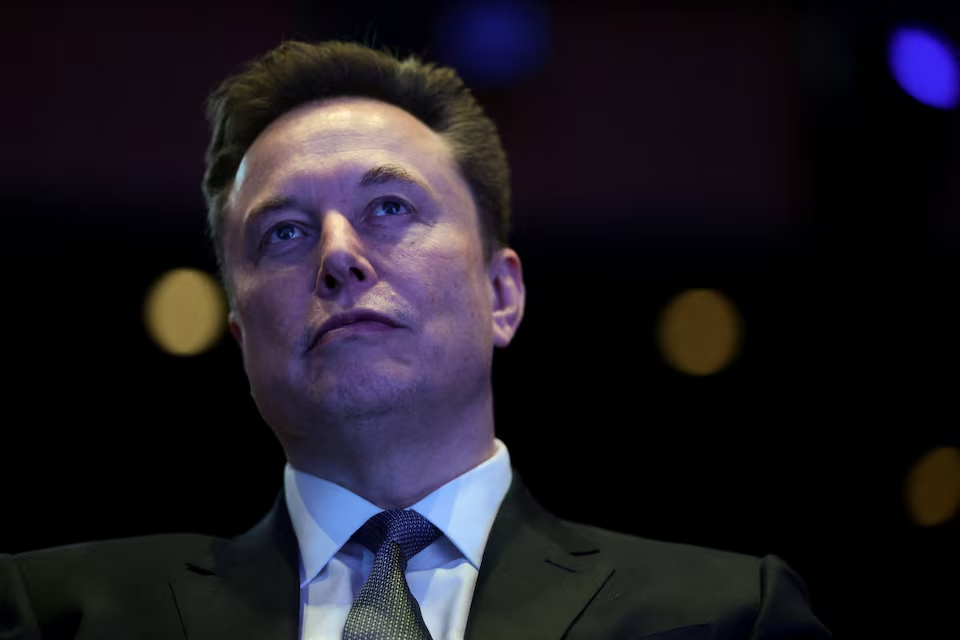
A U.S. judge has ruled that Elon Musk’s lawsuit against OpenAI can proceed to a jury trial. The decision marks a significant legal setback for the AI company. Musk alleges that OpenAI violated its founding nonprofit mission when it restructured into a for-profit entity. Consequently, the high-stakes trial is scheduled to begin in March, potentially exposing internal dealings at one of the world’s most influential AI labs.
The Core Allegations and Legal Stakes
Elon Musk, a co-founder of OpenAI in 2015, left the organization in 2018. He now runs xAI, a direct competitor. His lawsuit centers on a fundamental claim: OpenAI breached its founding contract and fiduciary duties. Musk contends he contributed roughly $38 million and strategic guidance based on assurances that OpenAI would remain a nonprofit dedicated to public benefit. He accuses co-founders Sam Altman and Greg Brockman of orchestrating a for-profit shift to enrich themselves, highlighted by multibillion-dollar deals with Microsoft.
The Judge’s Rationale for a Trial
U.S. District Judge Yvonne Gonzalez Rogers found “plenty of evidence” suggesting OpenAI leaders assured the maintenance of its nonprofit structure. She stated there were enough disputed facts for a jury to consider, rather than deciding the case summarily. The judge will issue a written order addressing OpenAI’s motion to dismiss. A key question for the jury will be whether Musk filed his lawsuit within the statute of limitations, a point OpenAI strongly contests.
OpenAI’s Defense and the Competitive Landscape
OpenAI has vehemently denied all allegations. The company labeled the lawsuit “baseless” and part of a “pattern of harassment” by a “frustrated commercial competitor.” In court, OpenAI’s lawyers argued Musk failed to provide a sufficient factual basis for claims like fraud and breach of contract. Microsoft, also named as a defendant, urged the judge to dismiss claims against it, arguing no evidence showed it “aided and abetted” OpenAI’s alleged wrongdoing.
A Battle Amidst an AI Arms Race
The legal showdown intensifies the broader competition for AI dominance. Musk’s xAI and its chatbot Grok compete directly with OpenAI’s ChatGPT. This trial could reveal sensitive details about OpenAI’s internal governance and its pivotal partnership with Microsoft. For ongoing analysis of AI industry dynamics, the Stanford Institute for Human-Centered AI provides valuable research.
Potential Implications and What Comes Next
The trial’s outcome could have far-reaching consequences. If successful, Musk could recover unspecified monetary damages from what he calls OpenAI’s “ill-gotten gains.” More importantly, a verdict could challenge the legal legitimacy of OpenAI’s hybrid for-profit/nonprofit structure. It also raises foundational questions about ethics and accountability in commercial AI development.
Key Dates and Next Steps
The trial is currently scheduled for March 2026 in Oakland, California. Both sides will now engage in intensive pre-trial discovery, potentially involving depositions from key figures like Sam Altman and Greg Brockman. The judge’s forthcoming written order will provide clearer procedural guidance. For background on corporate structure disputes, see our analysis on nonprofit conversions and fiduciary duty.
A Pivotal Moment for AI Governance
The judge’s decision to send the Musk vs. OpenAI lawsuit to trial guarantees a public, high-profile examination of the AI sector’s foundational promises. It pits Musk’s narrative of a betrayed mission against OpenAI’s defense of its evolution as necessary for safe, scalable AI development. Beyond the legal damages, the trial will test the very idea that AI companies can balance lofty ethical charters with the immense capital demands of the industry. The March trial will therefore be a landmark event, scrutinizing not just a contract, but the soul of a revolutionary technology.